INDUSTRIES / AI & HYPERSCALE
GPUs ramp in seconds. The grid answers in 1–90 minutes.
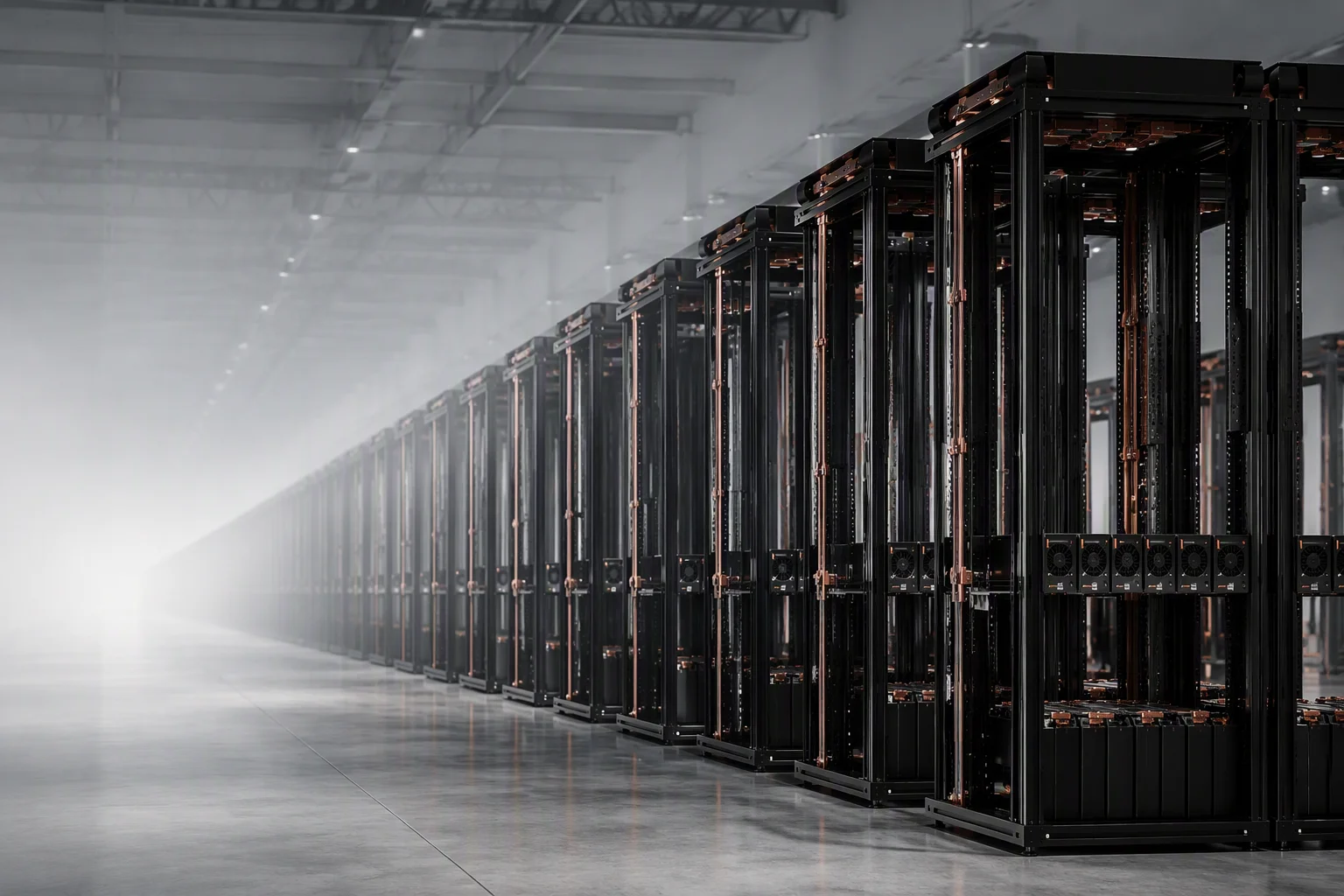
An NVL72-class rack draws 132–142 kW — roughly ten legacy cabinets — and a single hyperscale campus now asks the utility for 100–750 MW. VoltFab builds the distribution, backup and buffering chain that holds those racks through every swing.
INDUSTRY SNAPSHOT
| Rack power | 30–100+ kW standard · 132–142 kW NVL72-class |
|---|---|
| Site demand | 100–750 MW per hyperscale campus |
| Grid window | 1–90 min generation response vs second-scale ramps |
| Peak lever | ~30% grid demand cut via on-rack storage smoothing |
| Power path | 800 VDC feed → busway → PDU → PSU / BBU / supercap |
| Export | UN38.3 + MSDS + PI965/PI966 lithium pack |
THE DENSITY GAP
Ten times the rack, on the same utility feed.
Five constraints decide whether a 142 kW rack program ships on schedule — none of them existed in the 7–10 kW era.
| Constraint | Legacy baseline | AI-era reality | What it breaks |
|---|---|---|---|
| Rack power | 7–10 kW per cabinet | 132–142 kW per NVL72-class rack | Branch wiring and 32 A PDU feeds run out of ampacity |
| Load shape | Flat, predictable draw | GPU power swings second by second | Unbuffered droop trips PSUs mid-training run |
| Grid interface | Utility tracks a stable plan | Generation responds in 1–90 minutes | Ramps outpace the grid without a rack-level buffer |
| Site scale | 5–20 MW buildouts | 100–750 MW single-site requests | Interconnection queues, not steel, set the go-live date |
| Energy bill | Efficiency as a nice-to-have | ~30% of peak demand removable by smoothing | Every lost percentage point is bought at 100+ MW scale |
VOLTFAB RESPONSE
Feed it from above. Buffer it inside the rack.
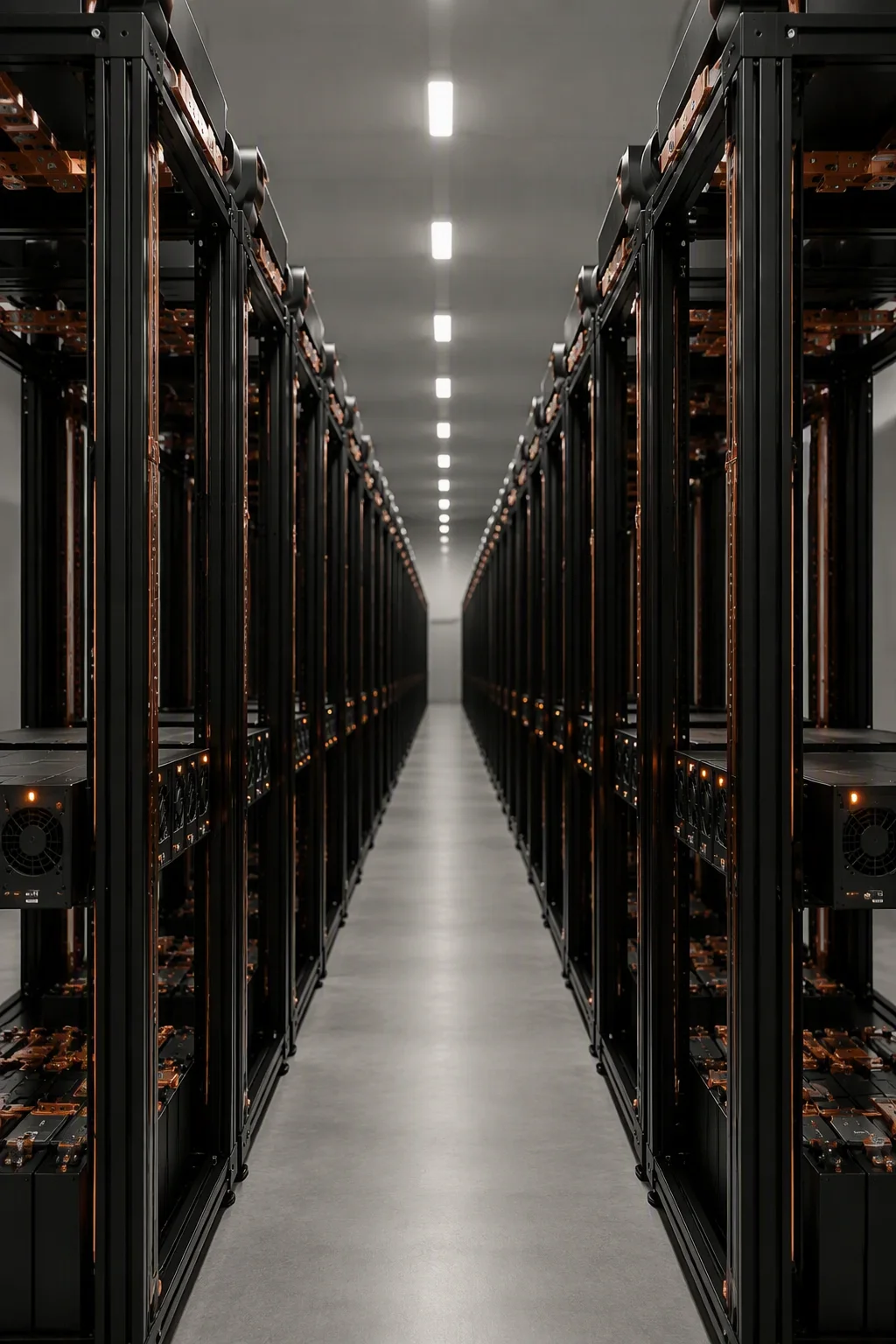
An 800 A overhead busway run lands feed at the rack top without a cable forest. Inside, 54 V CRPS supplies convert once at Titanium-class efficiency, a 51.2 V LFP BBU bridges the seconds-to-minutes window the grid cannot cover, and 48 V hybrid LIC supercapacitor modules absorb the millisecond transients — the same smoothing lever NVIDIA publishes as worth roughly 30% of peak grid demand. Because busway, PDU, BBU and supercapacitor come off one production floor, a ramp-up schedule has exactly one vendor to hold to it.
ENGINEERING BASELINE
What an AI rack power spec states in 2026.
Bring this table to the design review — every row maps to a line we build.
| Layer | 2026 requirement | VoltFab delivered value |
|---|---|---|
| Overhead feed | 800 A class track busway, UL 857, tool-free tap-offs | 160–800 A open-channel copper, 100% factory pre-tested |
| Rack distribution | 3-phase 63 A PDUs with outlet-level visibility | ±1% metering, up to 48 C19/HDOT outlets, 0U mount |
| Conversion | 5.5 kW+ 54 V power shelves, N+N hot-swap | CRPS/mCRPS ladder to 5.5 kW+, 96% Titanium @50% load |
| Bridging backup | Cover 1–90 min grid gaps with checkpoint time | 51.2 V LFP rack BBU, UL 1973 / 9540A path, 30–45 day lead |
| Transient buffer | Millisecond response, deep cycling tolerated | 48 V hybrid LIC modules, 100% DoD, ~15-year service life |
| Program shape | Pilot before ramp, export docs in the carton | 48 h DFM feedback, UN38.3/PI965-966 pack, FOB/CIF/DDP |
RECOMMENDED LINES
Three lines carry the AI brief.
Data Center Busway
160–800 A open channel, UL 857 listed and IEC 61439-6 type-tested. Project-quoted per run with 45–60 day lead.
Explore →BBU Battery Backup
51.2 V LFP for ORv3 shelves on a UL 1973 / 9540A path. 50-set MOQ with the UN38.3 export pack included.
Explore →Supercapacitor Modules
48 V hybrid LIC arrays buffer GPU transients at 100% DoD. Millisecond response and ~15-year service life.
Explore →FAQ
AI power questions from recent RFQs.
Can one 800 A busway run realistically feed 142 kW racks?
Why install both a BBU and supercapacitors in the same rack?
How does ~30% peak reduction reach the utility bill?
AI RACK PROGRAM